Twenty years back when it first hit the airwaves, this sure was a crowd-pleaser in Christian households. Based on the real life of deaf F.B.I. agent Sue Thomas, it combined the intrigue of police investigations with the unique comic pairing of the courageous but somewhat naive Sue and her lovable but not-always-so-well-behaving hearing dog Levi. The shows were generally tame, but not lame; a Christian series where the acting might not have been Oscar-worthy, but was never cringe-worthy either.
In the pilot episode Sue starts her new job in the FBI and concludes that she was just a diversity hire, and isn't happy about it. But her lip-reading abilities soon catch the attention of agent Jack Hudson who realizes that Sue has just the skill-set their surveillance team needs.
Cautions
When Jack Hudson first learns Sue can read lips, he challenges her to tell him what one of his colleagues 50-feet away is saying. It turns out he is making weekend plans with the woman he is sitting with. But, as Jack shares with Sue, that woman is not his girlfriend. This two-timing is a minor plot element, but makes what might otherwise be an all-ages show something better suited to older teens and adults.
Conclusion
I've only previewed the first episode to this point, but found it utterly charming, and look forward to watching the other 56 episodes. Canadians and Americans will be able to watch the pilot episode below (unfortunately, the video won't work outside of North America) and find more on Encourage TV on YouTube here (you'll have to use their search function to find the others).
You can also watch it for free on RedeemTV here, though you'll need to sign up for a free account. The advantage to doing so is that it is much easier to sort through the episodes there.
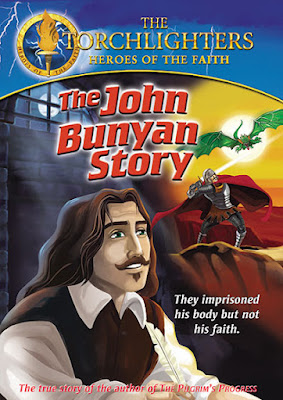
What is likely the most influential novel of all time was written by a man of little education, though with a lot of free time on his hands. John Bunyan may have written his most famous work, The Pilgrim's Progress, during his 12-year stay in prison for preaching in an illegal church. For those that aren't familiar with it, the book is a metaphor for the Christian life, with a pilgrim traveling from the "City of Destruction" to the "Celestatial City" and along the way having to contend with all sorts of trials and temptations personified (like a giant named Despair, or a judge named Hate-Good). Bunyan, by his own account, was not a nice young man, so he understood temptation. And once he became a Christian, he paid a price for it, so he knew trials. And this animated account gives a great, engaging overview of it all.
However, the film does indulge in creative license, taking as literal the opening lines of The Pilgrim's Progress, where Bunyan wrote "...as I slept, I dreamed a dream. I dreamed, and behold, I saw a man clothed with rags..." They portray the book as being inspired by Bunyan's dreams during his time in jail, and while that might even be true, it's disputed when exactly Bunyan first started writing his bestseller, so the facts are harder to come by than it might seem here.
Cautions
So one caution might be that younger viewers should be told not to make much of the little details, which may or may not be true.
The other caution concerns age-appropriateness. This is animated, so parents might think it is for little children. But a battle scene when the young Bunyan is a soldier shows a man next to him getting killed by a musket ball. The scene is made all the more dramatic when the distraught Bunyan cries out in grief, reaches for his now dead friend, and discovers that his own hands are now covered in blood. This wouldn't bother a ten-year-old, but some younger children will be disturbed. There's also a dream sequence with a dragon attacking Bunyan. Again, not overly scary by teen standards, but it could be a bit much for preschoolers.
Contents
I've rated this an 8, but that's only for an audience that's read Pilgrim's Progress – those that don't already know the book, won't be too interested in learning about the man behind it. But if you do know it, this will be an engaging half-hour's viewing. Our family, from eight all the way up, quite enjoyed it.
Watch it below for free (with some commercial interruptions).
This must be the most expensive documentary ever made by creationists and it is certainly the best looking. Creation Ministries International (www.Creation.com) spent more than $1 million staging and filming key events in Darwin’s life, including his time on the HMS Beagle and his visit to the Galapagos Islands. The production values are simply astonishing: solid acting, slick computer graphics, gorgeous close-up shots of the Galapagos wildlife - and a narrator with the perfect classical British accent.
The producers wanted to make this as good as anything you might see on the Discovery Channel, or on a PBS or CBC documentary because they aimed to get it shown on public TV around the world. However, that aim also impacted how they presented the content. If they wanted to get it shown on a channel like CBC they certainly couldn’t make it explicitly Christian(!) so rather than being a defense of Biblical Creation, the documentary limits itself to critiquing Darwinian Evolution.
The end result, then, is a persuasive, gorgeous, tactful, hour-long takedown of Darwin – the lie is exposed. The downside is that there isn’t much here pointing people to the Truth. Some have criticized this as a job only half done. That might be, but the half that it does do, it does brilliantly.
You can watch the trailer below, and buy it on DVD, or search for it on your streaming service.
This documentary is a couple of decades old now, and it's more important than ever. When it was released, it had cutting-edge computer graphics unveiling the inner workings of the cell, and it told the story of the origin of life research current to that time. Today, it also serves as a history of the early days of the Intelligent Design (ID) movement, highlighting key figures in it like Phillip E. Johnson, Stephen C. Meyer, Jonathan Wells, William Dembski, Michael Behe, and Dean Kenyon.
Kenyon had previously written a textbook in support of evolution, and Behe had also begun his career as an evolutionist before reassessing after he read Michael Denton's Evolution: A Theory in Crisis. As he describes it, reading this book made him feel like he'd been cheated; he'd had years of scientific education, was on faculty at Lehigh University, and he'd never once heard of the many problems with evolutionary theory! We get to come along as Behe and Kenyon explain how their eyes were opened.
We also get presented key ID arguments like Irreducible Complexity, which proposes that some biological machines need all their pieces to work, and could never have been formed by evolution's step-by-step process. This is an issue being as hotly debated today as it was back then.
Other highlights include a look at the bacterial flagellum, which is effectively an outboard motor on a bacteria, propelling it as much as 100,000 rotations a minute. This is a marvel of engineering, evidencing the brilliant Designer behind it.
And we're shown how biological machines are needed to assemble biological machines, which make the question of how they could have first formed one that evolution seems incapable of answering. It's a chicken and egg problem: which came first, the Machine A, needed to assemble Machine B? Or was it Machine C, which was needed to assemble Machine A?
Cautions
The ID Movement looks at the origins debate from a philosophical and scientific, but not religious perspective. They argue that evidence outside the Bible makes it clear there is a Designer. On this point, the apostle Paul, writing in Romans 1:20, agrees. But the weakness with ID is that it doesn't give the glory that is His due specifically to the God of the Bible. ID has a "big tent" approach which includes other religions, and both those who believe in a young Earth and those who believe it is more than 4 billion years old. However, this documentary doesn't touch on old ages.
Conclusion
While the computer graphics aren't as cutting edge, they are still amazing. We get a closeup look at the operation of micro machines we never knew about, but which are in our own cells! This is a must-see for high school science classes, and it could make for fascinating family viewing too with teens and parents.
Speaking of the classroom, Illustra Media has packaged this exact same material, in a slightly different order, in Where Does the Evidence Lead? (2003). There it comes in 6 distinct chapters, all around ten minutes long, making them easy to present one or two at a time in high school or university classrooms. Illustra Media has made that repackaged version available for free online, and you can watch it below.
Part 1 - Life: the Big Question (10 min)
We being with Darwin, his trip to the Gallipolis Islands, and how he developed his theory of Natural Selection.
Part 2 - What Darwin didn't know (8 min)
We're introduced to Michael Behe, who explains why he used to be an evolutionist: no one had ever previously presented him with any problems with evolutionary theory. But the more he learned about the cell, and how complex the simplest block of life is, the clearer it became that chance processes couldn't explain it. One example: the bacterial flagellum motor, which has been called "the most efficient machine in the universe."
Part 3 - Molecules and mousetraps (12 min)
In Part 3 we're introduced to the concept of "Irreducible Complexity" which proposes that in biological systems there are some machines that could never have come about by a step-by-step process – they would have to come together all at once. That is a powerful challenge to evolutionary theory, which precisely proposes everything can come about by small incremental steps. Michael Behe illustrates this point using a mousetrap as an example.
In answer, evolutionists have proposed their own theory of "co-option"... which has its own problems.
Part 4 – How did life begin? (11 min)
How did life begin in the first place? Darwin had very little to say on the subject. In recent years scientists have experimented with trying to get some form of "chemical evolution" started by mixing various chemicals together. But it isn't simply the chemicals that make life happen, but how the chemicals are arranged. Like letters in a sentence, we don't need just the right sort, but we also need them in the right order. The math here – the odds against even a single amino acid forming by chance – is fascinating!
Part 5 – Language of life (13 min)
Dean Kenyon wrote a best-selling textbook on the evolutionary origins of life. But then one of his students challenged him to explain how the first proteins could have been formed. Kenyon had originally proposed they would self-assemble, but what we were learning was that proteins are formed by other micro-machines, using instructions - there was no self-assembling. So Kenyon started to ask, what was the source of the instructions?
In this part, we also get to look into the cell to see how that information is put to use.
Part 6 – The Design Inference (14 min)
Design has been ruled out at the start – not by the evidence, but by mainstream Science's anti-Supernatural bias – as a legitimate answer to origins question.
But Man is fully capable of spotting and recognizing design. It is a legitimate field of scientific inquiry.
When a book is adapted for the screen, readers want it to be as close to the book as possible. So let's begin this review with a heads up: that did not happen here.
The central plot remains the same – these are women "in need of a husband" – but the setting has been updated to the modern-day USA, with five girlfriends all sharing a house just off-campus. Other departures include how the first love interest, Charles Bingley, came by his wealth: selling classical music CDs for dogs, and marketing them via late-night TV infomercials. And he drives a motor scooter. Oh, and Mr. Collins' proposal now has him make the compelling argument: "Elizabeth, we've been commanded to multiply and replenish the earth."
So if you aren't up for a light, silly treatment of your favorite book, this is not for you. That said, I do think it is for most everyone else. And if you've ever wished that someone today could write something like it, well, this is "something like it" indeed.
This version also adds an element glaringly absent from the book and every film version: a car chase!
Caution
There aren't many cautions to offer because, as it turns out, this was made by Mormons. Consequently, the violence amounts to a single fistfight played for comic effect. There's no sex, though it is alluded to twice, both times by the villain of the piece, Wickham. He first jokes that "there's only one reason people commit matrimony before they are 30” and follows that with a joke about being “relatively disease-free.” But his implied lack of chastity stands him in contrast with most everyone else.
The only other problematic element is a self-help dating guide called the “Pink Bible.” We had to explain to our kids that it was a “bible” only in the sense that it was purporting to be the final word on that subject – dating – as the Mechanics Bible would say it is for car repair.
Conclusion
This is not a faithful retelling of Pride and Prejudice. and yet it is a very good one, keeping remarkably close to the spirit of the book. That makes it the perfect date night movie for mom and dad, and a pretty good one for the whole family. The pacing is quick, the romance is sweet, and the humor is sprinkled liberally throughout. Of the 50 or so people I’ve watched it with, or loaned it to, somewhere near 90% have given it a thumbs up.
There are so many Pride and Prejudice films that if you want to find this one you should search for the title along with the year, or the title along with the word “Mormon." That’ll help you track it down.
I share the trailer below with some misgivings – the film is a lot better than this makes it seem.
This is a nature documentary that starts at the stars, and touches on just about everything else: lightning, squids, hummingbirds, seeds, snow crystals, DNA and butterflies are just a few of the highlights.
That’s both the strength and the weakness of the film. Some of this footage is as remarkable as anything seen on the Discovery Channel, or a National Geographic special, but each time a creature is investigated, we learn only enough to know we would really like to learn more… and then we’re on to the next bit of nature. But there is a method to this madness. The theme of God of Wonders is straight out of Romans 1:19-20: God has revealed Himself in the wonder of his creation. If we reject God, we can’t claim we did so out of ignorance – God, through his creation has left us “without excuse.”
Cautions
The pacing is a little slow, with maybe a few too many talking heads, compared to the nature footage, but once we're about ten minutes in, it gets rolling. That does mean, though, that even as this would be a great film to watch with a questioning friend – it could be a wonderful evangelistic tool – it won't work if that friend isn't at least a little patient.
Conclusions
For families used to watching documentaries, this will be another fun one to check out. The breadth of this presentation means there's sure to be something new to learn for everyone watching, from the youngest to the oldest.
You can watch itfor free in two different ways. It is available in "chapters" on the film's own website GodofWondersvideo.org/chapters.htm. The advantage to watching it in chunks is that it'll create the breaks needed for good discussions. But if you want to watch it for free in one go, you can find it (probably for only a limited time) here at the YouTube channel Christian Movies.
In the year 1890, seminary professor Russell Carlisle proposes teaching morality to the masses but without making mention of God. He reasons to his fellow professors that even if people don’t become Christians it would be a good thing if they were at least taught that stealing was wrong.
If that sounds familiar, that's the point. Director Rich Christiano, in his boldest and best film, is taking on the Christian trend of publicly defend God's Truth – about the unborn, or marriage, sexuality, gender and more – but without mentioning God Himself.
While we'll have to wait a decade or two to see how that approach plays out for us, Professor Carlisle gets his feedback in a much more immediate fashion – a colleague uses a time machine to send the professor one hundred years into the future. Upon arriving in present-day America, Carlisle sees that morals founded on anything but God have no foundation at all, and are just dismissed as opinion.
While the film has a serious point, the time travel duck-out-of-water angle allows for some comedy too. However, Carlisle isn't as shocked by modern-day technology as he is by modern-day spiritual malaise. He's surprised to meet someone who works on Sunday and doesn't attend church regularly. And when he's taken to a movie theater, he finds the film shocking, and not because of the violence or sex. As the time traveler runs from the theatre he shouts:
“Stop the movie! You must stop this movie! The man on the screen just blasphemed the name of the Lord! There must be some mistake – you must stop this movie, this is an abomination!”
Cautions
Only caution I could think of is one use of the word "gosh."
Conclusion
This is a solid movie with an important and powerfully presented Christian message. From simply an entertainment perspective, it gets a 7, but its deeper point means this is a cut above most other Christian fare.
Because there isn't much action, and maybe a few too many philosophical discussions, this won't keep the attention of younger kids. But for mid to older teens, it could be a fantastic one to watch and discuss with parents. You can watch the trailer below, and rent the film online at various places.
This is the (mostly) true story of Winnie, the bear that inspired A.A. Milne's much loved Winnie the Pooh books. While she lived most of his life in the London Zoon, many don't realize that Winnie was a Canadian bear. So it was very fun to learn how he got from the wilds of Canada to inside the pages of everyone's favorite children's story.
I think copyright concerns probably kept producers from using the words "Winnie-the-Pooh" but as the film begins, the connection is made, with an adult Winnie being watched by a man and boy who are unnamed, but unmistakable as Milne and his son Christopher Robin.
"Father," Christopher Robin asks, "why do they call her Winnie? It's a funny hame for a bear. I wonder how she got it"
"Yes, I wonder," his father replies. "I bet it's quite a story."
From there we are taken back in time, and across the ocean to meet a group of veterinarians, enlisted in the Canadian army, riding the rails across the country on their way to the front lines of the First World War. Aside from the bear, the star of this piece is Harry Colebourn, and we're introduced to him just as he wins a sizeable pot of money from his fellow soldiers. But he's not rich for long, as at the next stop, in White River, Ontario, he sees a bear cub chained up. Colebourn uses his money to buy the bear and rescue it. But now that he has it, what is he going to do with it? When he takes the bear back to the train, his regiment adopts it as their mascot and it's named Winnipeg – Winnie for short – after Colebourn's hometown.
From then on we get to see both Winnie's story and the story of this veterinarian regiment.
Caution
The only caution concerns what one reviewer called the film's confusion about its target audience.
It's about the most beloved bear of all time, so wouldn't this be a perfect one for the kidlets? The pacing is gentle, with the tension being mostly of a kiddish sort involving Winnie getting into things she shouldn't, and owner Colebourn, and his friends, trying to chase her down before they all get into more trouble.
But if this is for children, then why the repeated scenes with the mentally unbalanced, and at one point drunk, general in command? And if it is for kids, then what were producers thinking when they had the young vet Macray, distraught by the battlefield deaths of his friends and animals, grabbing a gun and running off to his death? The violence is muted - we don't see any blood and gore, even in the midst of fallen men and animals and we never see or hear Macray get shot. The violence is of the sort you might find in a Hallmark film (in fact, I wouldn't be surprised if this is on the Hallmark Channel). But you don't kill off charming characters in a children's film.
So parents need to understand that, despite some appearances to the contrary, this is not one for kids. Or at least not kids who are of the age that they are being read Winnie-the-Pooh stories.
Conclusion
Who would enjoy this? This would be a nice one for mom and dad on a night when they want something quite calm. It is a unique chapter in Canadian history, presenting not just a bear's story, but also showing some of the First World War from a Canadian perspective. There's humor, hijinks, and also a little educational content along the way so all in all, it ranks as quite a good TV movie.
The genesis of the film started back in May of 2007 when leading atheist Christopher Hitchens and Reformed pastor Douglas Wilson were asked by Christianity Today to dialogue on the question “Is Christianity good for the world?” Their wrote six exchanges which were printed in the magazine and then, in 2008, compiled into a book. When the two men headed out to do an east-coast book tour, filmmaker Darren Doane tagged along. He captured their exchanges and interactions, both on stage in formal debates settings, and as they conversed over a pint of beer in the local pub. The end result is the most entertaining and enthralling debate you will ever see on film.
But its appeal is not the reason this is a must-see film. You should see Collision because:
It prepares our childrenfor what they’ll encounter at university. The attacks that Hitchens levels against God and Christianity are mimicked on secular campuses so Wilson’s able defense of the Faith will be instructive and will be an encouragement to our young people when they face these same attacks from their professors and fellow students.
It demonstrates the approach we need to take to answering the theistic evolutionists.How are we to understand Genesis 1-11, and what role should Science take in guiding our interpretation of these chapters? To properly answer it we need to rediscover a mislaid aspect of our Reformed heritage – presuppositional apologetics. Throughout Collision Wilson brilliantly demonstrates (though doesn’t really explain) this distinctly Reformed way of defending the Faith.
So what is presuppositional apologetics? And how does it compare to the other, evidential approach?
Evidential apologists figure if we present the evidence – enough of it, and the right sort – people will follow the facts and come to realize that there is indeed a God. The problem is, facts are always interpreted and there is no agreeable common “neutral ground” that both sides can meet on to examine those facts. Present someone with information about the stunning intricacy of the human eye and they’ll fall back on their worldview – their presuppositions – to tell them how to understand this information. A Christian will look at the eye and acknowledge it as evidence of a great and wonderful Designer while an atheist will understand it instead as evidence of millions of years of evolution, since something this amazing couldn’t have just sprung up overnight! Confronted with the same evidence, they come to opposing conclusions because sin taints even our intellect – even our reasoning – so evidence can be twisted to support two radically different worldviews.
Presuppositional apologetics delves into the assumptions – the presuppositions – that underlie every worldview. When, in Collision, Hitchens accuses God of being a tyrant for ordering the death of the Amalekites (Deut 25:19), Wilson asks Hitchens to provide, from his atheistic worldview, a grounds for being upset. If we are just “matter in motion,” as the atheist worldview contends, what reason is there for Hitchens to care what happens to Amalekites? Hitchens makes repeated moral claims, and Wilson repeatedly shows his atheistic worldview gives him no basis for claiming anything is wrong, or anything is right. While Hitchens has debated a throng of other Christians it’s only Wilson, and his presuppositional apologetics, that’s given him pause.
We can learn from Wilson and use this same approach to properly answer the theistic evolutionists in Christian circles. Like Wilson, we need to cut to the very core of the debate and address their presuppositions – we need to ask how evolution can fit with Christianity when it requires a mythical Adam and Eve, millions of years of mutations and mistakes, and Death before the Fall?
This is a film some will love, and others might find too loud (the producer has shot music videos in the past, and that influence is felt here in the driving, beat-y soundtrack), but the meat of what’s discussed, and the example that is set in the discussing, will be valuable for all ages and all interests. Would that everyone would watch this one!
Eric Liddell is best known for the stand he took to not compete in the 1924 Olympic 100-meter race. He was among the United Kingdom's best chances at a medal, but he didn't want to run because doing so would require him to run in a heat on Sunday. Despite enormous pressure to compromise for the sake of his country, he still refused, pointing to the 4th Commandment's call to "remember the Sabbath Day, to keep it holy." His country was important to him, but it came a distant second to his God.
Eventually, a different sort of compromise was struck, which had Liddell run in the 200 and 400-meter races instead, winning a bronze and a gold. His firm convictions, and his outstanding athletic performances, were the subject of the 1981 film (and Oscar winner for Best Picture) Chariots of Fire. However, Hollywood indulged in a bit of artistic license. They made it seem as if Liddell only found out about the Sunday heat on the boat ride to the Paris Olympics, but the truth, as shown much more accurately in this animated video, is that Liddell knew months before.
While both film and video cover Eric-the-athlete, this video covers his later years too, as Eric-the-missionary. Liddell was born in China, to Scottish missionary parents, and while educated in Scotland, actually spent most of his life in China. He returned there after the Olympics, serving as a missionary from 1925, until 1943, which is when the Japanese invaded. He could have fled, and he did send his family away, but Liddell stayed to continue telling the Chinese about God. That cost him, as he ended up in a Japanese internment camp, but even there he remained a faithful witness until his death in 1945, likely due to a brain tumor.
Cautions
This would have gotten at least a 7/10 if not for the choice the creators made to have Chinese characters speak broken and stilted English – their inarticulate language skills make them look a little dumb. Liddell was raised in China, which means his Mandarin was likely excellent, and for important conversations, they likely would have all used the language they all knew well, and his Chinese friends could have been shown speaking clearly and articulately in their native language. Maybe I'm wrong. Maybe they were all trying to learn English, and so that's the language they all spoke all the time, some better, and many worse. But I doubt it, and that's why I knocked a star off what is otherwise a solid account of a faithful and fascinating man.
Also, as noted earlier, Liddell does die in a Japanese camp, and while that is not depicted, if you have some sensitive younger souls, you might want to give them a heads up early on, so that ending doesn't come as a shock.
Conclusion
This is more educational than entertaining, but I think families could enjoy watching this together – that it is a true story does make it compelling. To say it another way, this might not be the sort of video your kids will ask mom and dad to put on, but if you start it going, and the whole family is watching together, I don't think there will be many complaints. So watch this with the family and be inspired by a man who knew that God was worthy of all honor, and most certainly came before fame and before his own safety.
You can watch The Eric Liddell Story for free below, though with quite a lot of commercial interruptions. For an ad-free presentation, you can sign up, also for free, at RedeemTV.com.
When their beloved Sparky is dognapped by the infamous international criminal known only as "The Clip," three college-age friends – Ethan, Jeffrey, and Christina – vow to find their pooch, no matter how long it takes. We join up with the search three years in – that's 21 doggy years! – and despite a Volkswagon van full of advanced tracking technology they still seem no closer to finding their four-legged buddy.
Sparky Chronicles is a Christian spy spoof, with sting operations, tranquilizer darts, explosions, and one chase scene after another. These aren't high-speed chases, mind you – and at one point the villain gets away by walking at a brisk trot – but that's the point. The pounding music, the quick cuts between the determined pursuers and their frantic prey, and then the shots of the speedometer needle slowly edging past 35: as spoofs go, they're pretty much nailing it.
So what makes this tweenish tale a Christian one? Well, during their long fruitless search the three friends come to realize it would be really helpful if they had some sort of guide to help them know which way to go. And when they happen upon a map that The Clip has left behind, Christina makes mention of how the Bible is the same sort of thing for life: a guide that tells us what's right and true. That's the lesson being taught, but unlike what happens in many a Christian production, this is an almost subtle presentation. Sure, they explicitly spell it out, but they don't beat kids over the head with it.
I'd recommend this for tweens, but younger kids might enjoy it too. And while this isn't going to be mom and dad's favorite, it'll be more interesting for them than some other children's fare. The only downside is that while things are set up for a sequel, there isn't one.
How would you define a cult? Some think of them as being deadly, like the 900 followers of Jim Jones who, in 1978, committed suicide en masse by drinking cyanide-laced kool-aid (this is the origin of the phrase “drinking the kool-aid“). What this documentary focuses on are religious groups that have some connections to biblical Christianity, but which have departed so far from it, that they are worshipping another God.
OVERVIEW
One of the film’s objectives is to give Christians an easily understandable way of spotting those departures. And to make it memorable, host Eric Holmberg uses the four common math symbols: + – x ÷. As he explains it, “A group can be classified as a cult when they:
Add to the 66 books of the bible…
Subtract from the triunity of God by either denying the personhood or the deity of one or more members of the Godhead
Multiply works necessary for salvation
Divide the loyalties of their followers from God…”
These math symbols are then used as the documentary’s four “chapters” and serve as logical breaks for any who might prefer to digest this 2-hour documentary in chunks.
1. Additions (starting at 24:50)
Holmberg explains that the first sign of a cult is that it will add to God’s Word, “relying on some new, so-called revelation. either new scriptures, or by the discovery of some new interpretive key to the Bible that has somehow been hidden from the historic church.” But why would such additions be needed? As Dr. Curtis Crenshaw notes: “If anything is contrary to Scripture, it is wrong. If anything is the same as Scripture, it is not needed. If anything goes beyond Scripture, it has no authority.”
2. Subtraction (starting at 47:30)
Cults will also subtract from the “triunity of God.” Sometimes this involves denying the Holy Spirit’s deity, but more often, it involves a denial of Jesus as being fully God.
3. Multiplication (starting at 1:11:35)
Another sign of a cult is that they multiply the works needed to be saved. This springs directly from the subtraction or undermining of Christ’s deity because, as Jerry Johnson highlights, when Christ is no longer God (or at least fully God), then his sacrifice will no longer suffice. And then Man will have to step in and do his own “share.”
“To downplay the divinity of Christ is to ultimately to surrender the doctrine of justification. Now, why is that? We must remember that God is holy, holy, holy. He is a thrice-holy God. Our mildest sin offends Him greatly….God doesn’t wink at our sin. God is offended by it. He doesn’t even want to look on us because we are not reflecting the character of being made in His Image. And when we think about that, and think about the fact that Christ came as deity to die in our place, that’s because our sins are an infinite offense to the infinite nature of God, and therefore an infinite payment had to be made, and we couldn’t make it. So to take away the deity of Christ does what? It opens up the door. You have got a satisfaction that isn’t a full satisfaction. It’s a partial satisfaction. And therefore, something else has to be added to it. And that’s what the cults always do. None of them believe in justification by grace alone through faith alone. They always add some works to salvation. Christ’s work is not complete, because Christ is not diety.
4. Division (starting at 1:35:40)
A fourth sign of a cult is that they will divide their followers from God so that their first loyalty belongs to the group or to the group leader, rather than to God.
CONCLUSION
The Marks of a Cult is a lot of things: a history of how some of the biggest cults began; a rebuttal to some of their aberrant theology; an explanation of how they have different definitions for key theological terms like grace and justification; and a primer on the beliefs that Christiandom hold in common. It is also entertaining – this is education made, if not easy, then at least engaging.
But it’s also important to mention what this is not: this is not a film you’d show your Mormon or Jehovah’s Witness friend to convince them they are worshipping a false god. This is a film for Christians, intended to clarify the conflict more than argue for the historic Christian side. That makes it a great introduction to the topic of cults. Those who want to go deeper can turn to the resources suggested throughout the film, including the likes of Dr. James White’s The Forgotten Trinity and Dr. E. Calvin Beisner’s God in Three Persons.
Overall, The Marks of a Cult is an outstanding documentary, and what’s even better, you can watch it for free below!
“The year is 2081, and everybody was finally equal. They weren’t only equal before God and the law you see; they were equal every which way. Nobody was smarter than anybody else. Nobody was better looking than anybody else. Nobody was stronger or quicker than anybody else…"
In 2081 a “golden age of equality” has been ushered in by the “Handicapper General” whose job is to assess everyone’s abilities and, if they have any advantages, to then assigns them “handicaps” to take them away. In the film’s opening scene we meet George who, being a little stronger than most, is sunk down in his easy chair by the heavy weights he’s been assigned to sap his strength. He’s also outfitted with earphones that hit him with piercing sounds to make it impossible for him to use his higher than average IQ. Meanwhile, his wife Hazel sits comfortably on the couch, knitting. She hasn't been outfitted with any handicaps because she's been deemed to have no advantages.
So they are equal. But is it an equality we want to have? Hazel and George are now just as fast, just as strong, and just as able to do math as one another. But this is an equality of the lowest common denominator. To bring this equality George's gifts had to be diminished until he was at Hazel's level. And for the government to bring about this type of equality, it had to treat them quite differently: Hazel is free, while George is in chains.
Surely this isn't what we mean by equality, is it? There must be some other, better sort?
While the film doesn't really direct us to the equality that is worth pursuing, the Bible does. In passages like Leviticus 19:15, Ex. 23:3, 1 Timothy 5:21, and James 2:8-9 we're pointed to a type of equality that involve treating all alike, not favoring the less advantaged over the rich, or the rich over the poor. Instead of endorsing 2081's equality of outcomes, God tells us to extend an equality of treatment.
2081 is so short I don't want to give any more of the plot away. But if you're looking for a great conversation starter, this is a fantastic film to watch and discuss, though be sure to do so with a Bible in hand. You can watch the trailer below, and to watch 2081 for free, follow this link (you do need to sign up to their email list, but they won't spam you, and you can always unsubscribe).
[SPOILER ALERT: the questions below do give away some more of the story.]
Questions to consider
In 2081 equality is said to have been achieved. But has it really? Are Hazel and George and Harrison equal to the Handicapper General? Can you think of any historical examples where governments brought a form of equality to the masses, that they didn't want to share in themselves?
Does the Bible support an equality of outcomes or an equality of treatment (aka. an equality of opportunity)? See Leviticus 19:15, Ex. 23:3, 1 Timothy 5:21, and James 2:8-9.
How is Hazel’s situation improved by George being handicapped? Why would she hate it if he removed his handicaps? How does Ex. 20:17 apply here?
Is income inequality (2 Chronicles 1:12; Ex. 20:17) something that God calls on Christians to fight? Is poverty (Prov. 19:17)?
What was Harrison Bergeron hoping to accomplish? If no one remembers his speech then did he die for anything? If we take an unsuccessful stand for what is right why could that still be worth doing? In what way is our measure of success different than that of the world's?
In 2081 the government controls every aspect of people's lives. Why do governments grow? Who is it, that's asking them to do more? What are the dangers of governments that get too big? (1 Samuel 8:10-22)
Aside from a change of setting, this is a faithful adaption of the source book. Yes, moving it from Vermont to England will leave viewers a little surprised, especially if they've grown up watching the 1960s Disney version. But accents aside, this is the more authentic version and if you loved the book, you'll love this film.
For those who don't already know, Pollyanna is a poor but cheerful girl who, after becoming orphaned, is sent to live with her very rich, and very strait-laced aunt Polly. The two have very different ways of viewing the world, with the joyful Pollyanna seeing nothing but wonder, despite the losses she's faced, and aunt Polly seeing nothing but the problems, despite the riches that surround her. So whose worldview is going to win out? Is Pollyanna going to stop giving out hugs, or is her aunt Polly going to get over her reluctance to be touched? Something has to give!
One reason parents will appreciate this story is because of Pollyanna's "glad game." This is something her father taught her – he explained that even when things aren't going our way, there is always something to be glad about. He first taught her the game one Christmas when Pollyanna was hoping for a doll, but the only gift sent to her poor family was a pair of tiny crutches. So what is there to be happy about crutches? It took some thinking, but eventually father and daughter came up with something: they could be glad because at least “we didn’t need to use them!”
As Pollyanna gets to know the people in her new community, both young and old, she teaches her game to them, and in doing so, transforms her community - they too, start to see the silver lining to each dark cloud. But what about aunt Polly? What is she going to think about the game?
CAUTIONS
It's worth noting that the "glad game" can be taken to extremes. For an example, in the book, when an older man breaks a leg, Pollyanna notes he could be glad that he broke just the one leg. Well, okay. But, as the Preacher said, there is a time for everything, and that includes mourning. So maybe it is fine for the man to just simply be sad for a time at the pain and suffering that's happened to him.
That said, I don't think many of us are in danger of overdoing our gladness, so couldn't we all do with a good dose of this Pollyanna-ish thinking?
The only other caution concerns one shocking/sad moment that will cause young viewers distress – near the end of the film Pollyanna gets seriously injured. It all happens in a flash, so nothing gory is shown, but our girls needed to be reassured that Pollyanna would recover.
CONCLUSION
Young ladies are going to love this one, and I think young lads may even be up for it, with a little encouraging. And if mom and dad can get past the British accents, they, too, are sure to love this well-acted, authentic adaption of a timeless classic.
How can a mouse meet up with a hungry fox, snake, and owl, and live to tell the tale? It helps that he has a monstrously big friend who is just about to meet him. And a fox, or a snake, or an owl, wouldn't dare eat a small mouse who has such a big friend!
But...what if they found out what the mouse knows: "There's no such things as a Gruffalo"?
Or is there?
This short film, based on the book of the same name, is a clever tale about a mouse who thinks his way out of trouble. It is beautifully rendered, visually and musically, with the only concern being that everyone wants to turn this little mouse into a little morsel. So in our household the pause button had to be used a few times to calm some anxious viewers. For those under eight, especially if they don't watch much TV, there is a little bit of tension here. In fact, kids under three might find it just too scary.
But it does all work out in the end, and reassuring any little ones of that might help them make it through.
So, two thumbs up for this short, fun, and clever story.
There is a sequel, The Gruffalo's Child, about the title character heading off to search for the "big bad mouse" that so terrified his father. But it loses the charm of the original because now it is a father who lies to his child, rather than, as in the original, a mouse lying to predators. While we can justify lying to predators it is quite another thing for a parent to lie to their child. Also, the moody music, and the uncertainty about who we should be cheering for (the Gruffalo child, all on his lonesome searching through the woods, or the mouse that he is, basically, hunting?) make this one a good bit scarier than the original. That's why our family is going to give it a miss.
Animated / TV series / Family
2001 / 300+ minutes (26 episodes)
RATING 8/10
This educational series takes place on a small island in which everything appears quite modern...except for the wooly mammoths everywhere.
On Mammoth Island everything is mammoth powered. Your house is cold? A mammoth in the living room will keep things toasty warm. Need hot water for your shower? Tickle the trunk of a sleeping mammoth in just the right spot and he'll provide a warm spray. Need to deliver the mail, or coconuts, or pizzas? Mammoths are there to help!
Except, as the residents keep discovering, mammoth power has a definite downside. Mammoth pizza delivery? Too slow. Mammoth-powered house heating? Too risky - if it wakes up you may end up with a mammoth-sized hole in your living room wall.
The way each 15-minute episode works is that after a particular deficiency in mammoth power is shown, then a new resident to the Island, known as the Inventor, works with a 14-year-old island resident, Olive, to see if they can come up with something better. And that something better involves the use of machines, both simple and more complex.
For example, in the first episode they explore how inclined planes can make it easier to lift heavy loads – it's easer for the mammoths to roll boulders up a gradual slope rather than just heave them straight up. A few of the other machines and devices that get invented (or rather, re-invented) include:
Levers
Wheels and axles
Belts and gears
Pulleys
Springs
Screws
Engines
Pumps
Steam power
The series is aimed for Grades 3-6, but my girls, who are all Grade 1 and under, really enjoyed it. I did too. There are so many kids shows that are absolutely brainless, and I can't sit through them. But this one was a pleasure to watch - there was lots for me to learn too.
I'd guess that even my oldest girl only understood about half of the explanations - it really is intended for at least Grade 3 – but it did spark her imagination. Every show includes an invention, and she was inspired to try to make her own creative creations.
Cautions
There is only one mild caution to note: one character, Brenda, is a negative nag. She is the nay-sayer who always says the invention isn't going to work. In small doses, that's no big thing. But if you watch this series over the course of a couple weeks, like we did, it does get a bit tiresome. And, particularly with younger audiences, it might then be good to note that Brenda is not being a team-player or a good example.
I was wondering, because of all the mammoths, whether the series would bring up evolution. However, that topic is never raised. There are mammoths on this island, but no reason is ever offered as to why.
Conclusion
This is a great series for the whole family to enjoy - younger kids will love the humor, and older children and even teens and adults, can learn a little something from it. Also, the short 15-minute episodes make it a nice way to watch a moderate amount of TV - the family can watch an episode or two without running through the whole afternoon.
The series takes it's inspiration from author/illustrator David Macaulay's The Way Things Work children's book, and while I've only skimmed through it, it looks interesting too (and mammoths also have a starring role).
I should note that while The Way Things Work is a fantastic television series it is definitely not one to buy. Here in North America this 26-episode series goes for more than $500 and his marketed only to schools and libraries. That's where we got it - from our local library, where all the episodes were available, with no waiting. I've checked a few other libraries across Canada, and it's in many of them too. So check it out - our family highly recommends it.
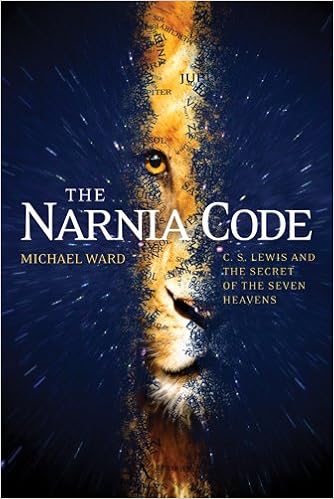
The Narnia Code
59 minutes/ 2009 RATING: 8/10 The Da Vinci Code and The Bible Code had me close to swearing off anything with the word “code” in the title, but this documentary made me glad I held off. It is based on a book of the same name that argues C.S. Lewis modeled the seven books of his Narnia series on the seven planets of the medieval cosmology.
It is an argument that has intrigued and convinced many Lewis scholars. There seems good reason to believe the Lewis did add this extra layer of meaning and artistry to the books, and that, in a bit of patient playfulness, he was content to never make mention of it, leaving it for someone – as it turned out, a certain Michael Ward – to discover 50 years later.
For a detailed look at the theory itself, viewers will need to go to the Bonus section of the DVD. The main feature focuses more on the discovery of the planetary connection, the excitement it caused, and why so many people today still get excited by what this man wrote.
This is, admittedly, a documentary that will excite only a very particular audience: Narnia lovers who are equally fascinated by the tales' author. But for them, well, this brilliantly executed BBC production will have these folk scurrying off excitedly to their bookshelves and paging, once again, through these old favorites!
You can see the trailer below and learn more about the book and documentary at www.NarniaCode.com.
Solid high school science curriculum resources that aren't tainted by evolutionary assumptions are hard to come by. That's why it was so wonderful to find filmmaker Wes Olson's Biology 101 DVD series.
It proceeds from a young-earth 6-day-creation perspective, but this isn't so much a specifically creationist resource as a solidly biblical one. Olson isn't always talking about creationism and evolution, but is instead in awe of what God has done. That awe shows up in all he says.
Now there are time when matters of creation do come up. For example, in talking about genetics he throws in the quick comment that there are only three people who have not come about by the combination of their parents' DNA: Adam, made from the earth, Eve, made from Adam, and Jesus, made from Mary's DNA and the Holy Spirit. The creationist perspective also comes out in how this look into earth's various lifeforms is broken up. Olson has ordered the segments by what day in the creation week that the organism was made. So, we start with plants on the third day, then look at aquatic and avian creatures which were made on the fifth day, and so on.
It looks good
Production values are solid throughout. There are piles of pictures and film clips of the creatures being discusses, and Olson, as narrator, has a delightfully dry wit. This is evidenced in the many short extra bits of information he includes, such as this:
"Ostriches are the largest birds, standing over eight feet talk, and the fastest two legged runner, sprinting nearly 45 miles per hour. Roadrunners, on the other hand, have a top speed of only 17 mils per hour, chasing lizards and snakes. Coyotes have a top speed of nearly 30 miles per hour, almost twice the speed of a road runner. Just in case you were wondering."
And sometimes it is the extra bits of trivia that serve to make his points more memorable. In talking about recessive and dominant genes he noted how dark hair was dominant over light, and,
"...incredibly the gene for having 6 fingers on one hand is dominant over the gene for having only five fingers on one hand, but practically everybody carries two copies of the five-fingered gene, which is why you almost never see someone who has six fingers on one hand."
Six fingers is dominant? I'm going to remember that. And in remembering it, I'm going to remember the difference between recessive and dominant genes.
Contents
This is meant as a high school biology course. However, it is only 4 and a half hours long, and while it comes with a 118 page textbook (on pdf, stored on one of the DVDs) it is less comprehensive than a high school biology course would need to be. So this would make a wonderful foundation for a course, but other materials would be needed to supplement it. The 9 episodes vary in length from as short as 15 minutes to as long as 44 minutes.
DISK 1
1. Introduction: Defining life and an explanation of organism classification systems
2. Plants
DISK 2
3. Aquatic creatures
4 Avian creatures
DISK 3
5. Land animals
6. More land animials
7. Mankind
8. More on Mankind
DISK 4
9. A brief history of the study of biology, the origins of genetics, and the moral questions involved in remaking our own genome
Audience
The course material is for ages 15 and up, but the content is appropriate for all ages. This focus on all-ages appropriateness does mean the discussion of our reproduction system is done in the broadest of strokes. We learn about how children are a combination of their mom's and dad's genes but no mention is made of exactly how those genes get mixed.
I'd highly recommend this to any Christian high school science teacher – whether they use it in whole or part, there's sure to be lots of it they will want to show their classes. It would also be an excellent supplement for any Christian child attending a secular high school; this is the perspective they'd be missing.
Families with an interest in this subject matter might also find this worth buying. I should note that while I gave this an 9 rating, that was for how it rates as an an educational resource – I can't think of any better. But from a solely entertainment focus, this would only score a 7. If you want to learn biology, this a wonderful method. If you want to be entertained, there are many more entertaining films out there.
You can find out more at the Biology 101 site and check out the 14 minute first segment and introduction down below. The 4-DVD Biology 101 set is $70 US on the website, but seems to be cheaper at Christianbooks.com and Amazon.com.
Chemistry 101 is even better
Wes Olson has also produced a Physics 101 series and a Chemistry 101 series. I haven't seen the Physics 101, but have had a chance to look at the Chemistry 101 series. I thought it was even better. Olson's approach to teaching chemistry is to lay it out as it was discovered – we go through it historically, learning about one discovery after another. I was rather surprised about how much of our knowledge of chemistry has only been discovered in the last 150 years.
This historical approach is brilliant and fascinating. I watched this one simply because I couldn't stop. But at 11 hours long it is a little over twice the material of the Biology 101 series....so I'm not done it yet.
I'm always on the hunt for films or shows my kids will enjoy that I'll enjoy too. There aren't many that fit that bill, but Jungle Beat sure does. This is comic genius at its best!
The videos are all 5 minute stand alone pieces featuring one jungle creature. Our favorite is probably the giraffe, or the turtle, but the bee, monkey and hedgehog are popular too.
While the videos do have sound, they remind me of the very best silent film comedies from Buster Keaton, and Charlie Chaplin, because they are entirely dialogue-free (after all, animals don't talk, right?) so all the humor is physical. Let me give you an idea of some of the scenarios:
What's a poor turtle to do when it gets an itch, but its shell won't let it scratch? Maybe it should just slip off its shell? But like a pair of tight pants, his shell comes off easily, but doesn't go back on nearly so quickly. This leads to some hi-speed hijinks when the turtle has to surf on his shell to evade an eagle that wants to eat the now-exposed turtle.
What's a poor firefly to do when it wants to catch some sleep, but its own light is keeping it awake?
What's a poor giraffe to do when he accidentally head-butts the moon and knocks it to the ground, where it breaks to pieces?
Each of the stories has a creative set-up, and all come with a happy ending. I don't know if Jungle Beat's creators are Christian, but I suspect so, because they've gone to great lengths to make sure this is family-friendly. So far there are more than two dozen short videos in total, which amounts to more than two hours of viewing, so gather round the family - you are in for a treat!
SEASON ONE
The producers have collected all 13 Season One episodes into one 65-minute video that they've made available for free on YouTube (and which you can watch below). From our two-year-old on up to mom and dad we all love them. We just wished there were more...
SEASON TWO
...and now there are! A second season, of another 13 episodes has been produced, and also made available as a 65-minute compilation, here below.
SEASON THREE
A third season is also available, but not on YouTube yet. So far as I can tell, only Americans can access it online at Amazon.com by clicking here, where the season (mislabeled as Season One) can be purchased for $8.99 (or watched for free if you have Amazon Prime).
You can also check out some screen saver downloads, and a trailer for a very fun-looking Jungle Beat game app (I haven't played it, but think we might buy this one - it's just $2.99) at their website: www.junglebeat.tv
I can't say enough good things about this series. It is so very clever, and other than a few moments of peril, which might have our two-year-old a little nervous, it is entirely safe. Two thumbs very enthusiastically up – I give this a 10 out of 10!
The world is ending and we don’t know why. In Ember’s opening scenes we learned for humanity to survive they have to hide underground for 200 years. That’s why a group of engineers and scientists – the Builders – have crafted a city, the City of Ember, and buried it deep underground so the residents can survive the apocalypse that is presumably killing everyone who remains above.
But now, after 200 years have passed, no one alive remembers there is another world out there – they only know of Ember, and the only light they see is provided by light bulbs powered by their mighty generator. However the generator – their whole city – was never meant to last forever, and now everything is starting to break down, and they’re running out of food too. The biggest problem? No one will admit what’s happening.
So to the rescue comes Doon Harrow, a teen with a knack for fixing things who wants to have a go at working on the generator. But to get at it he has to break rules and venture where he’s not supposed to go. When Doon’s friend Lina uncovers some long-lost and only partially intact instructions from the Builders the two of them have to piece together all the clues to figure out how they can save their family and friends before all of Ember’s lights go dark.
CAUTIONS
The film has no language or sexuality concerns at all.
However, there are a couple scenes involving a gigantic mole, roughly the size of a Volkswagon Beetle (the original, not the modern version) chasing Lina and Doon. This mole can tunnel through floors and walls, and seems intent on eating them. One moment in particular gave my movie-watching companion the shivers when the Lina reaches for a box just out of reach at the very same time as the mole’s slimy pink tentacle-like feelers also reach out for the box. This could be a bit too creepy for any kids under 10, or just anyone who has an aversion to icky things (spiders, octopuses, rats, etc.). While Lina and Doon escape the mole does seem to eat someone else, though this isn’t shown onscreen.
There are also a scuffles and such, but nothing graphic gory or all that violent.
The more notable caution would be the religious aspect of the film. God is never mentioned, and His absence in a movie about a coming end to the world is glaring. Instead of Christianity the citizens of Ember have oaths of loyalty to the city, and a quasi-cult that holds the original Builders in high esteem, expecting them to come back when they are needed to set everything right.
One more note: one of the villains has a club foot, and while it is common movie shorthand to have disabled or misshapen people as villains – Jack Elam's wandering eye got him typecast as the bad guy in every Western he was ever in – it’s important to point out to our kids what’s going on here, lest they unknowingly accept as true something that just isn't so. The moviemakers are showing us a villain's inner deformity by giving him an outer one - that's the movie shorthand. But they are making a connection that just isn't so. That's why this needs to be a point in the film where we hit the pause button, and help our kids spot the lie being told.
CONCLUSION
This is another film by Walden Media, the folks behind the Narnia films, and the owner of the company, Philip Anschutz is a professing Christian who has stated the intent of the company’s films is “to be entertaining, but also life affirming and to carry a moral message.”
Some of this Christian influence is evidence in the complete lack of language and sexuality concerns. This is so rare as to be astonishing.
But a post-apocalyptic tale is not your typical family fare. And a story in which the kids get something the adults are too dumb to understand promotes an all too common and entirely unbiblical disrespect for elders.
So this is an entertaining movie, and one with no sex or language concerns, and only a moment or two of violence/creepiness. But it is also a movie that shouldn’t simply be swallowed whole as simple entertainment – it needs to be discussed.