Showing posts with label Church history. Show all posts

Friday, July 1, 2022

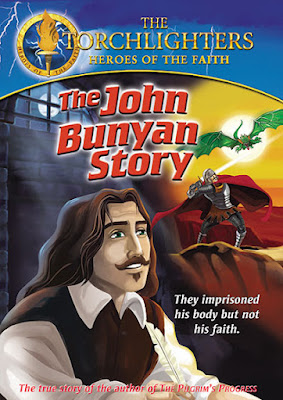
The John Bunyan Story

Animated
2006 / 29 minutes
RATING: 8/10

What is likely the most influential novel of all time was written by a man of little education, though with a lot of free time on his hands. John Bunyan may have written his most famous work, The Pilgrim's Progress, during his 12-year stay in prison for preaching in an illegal church. For those that aren't familiar with it, the book is a metaphor for the Christian life, with a pilgrim traveling from the "City of Destruction" to the "Celestatial City" and along the way having to contend with all sorts of trials and temptations personified (like a giant named Despair, or a judge named Hate-Good). Bunyan, by his own account, was not a nice young man, so he understood temptation. And once he became a Christian, he paid a price for it, so he knew trials. And this animated account gives a great, engaging overview of it all.

However, the film does indulge in creative license, taking as literal the opening lines of The Pilgrim's Progress, where Bunyan wrote "...as I slept, I dreamed a dream. I dreamed, and behold, I saw a man clothed with rags..." They portray the book as being inspired by Bunyan's dreams during his time in jail, and while that might even be true, it's disputed when exactly Bunyan first started writing his bestseller, so the facts are harder to come by than it might seem here.

Cautions

So one caution might be that younger viewers should be told not to make much of the little details, which may or may not be true.

The other caution concerns age-appropriateness. This is animated, so parents might think it is for little children. But a battle scene when the young Bunyan is a soldier shows a man next to him getting killed by a musket ball. The scene is made all the more dramatic when the distraught Bunyan cries out in grief, reaches for his now dead friend, and discovers that his own hands are now covered in blood. This wouldn't bother a ten-year-old, but some younger children will be disturbed. There's also a dream sequence with a dragon attacking Bunyan. Again, not overly scary by teen standards, but it could be a bit much for preschoolers.

Contents

I've rated this an 8, but that's only for an audience that's read Pilgrim's Progress – those that don't already know the book, won't be too interested in learning about the man behind it. But if you do know it, this will be an engaging half-hour's viewing. Our family, from eight all the way up, quite enjoyed it.

Watch it below for free (with some commercial interruptions).

Monday, May 2, 2022

The John Newton Story

Animated / Drama
2021 / 30 minutes
Rating: 7/10

We know John Newton (1725-1807) as the former slave ship captain who repented and then wrote the amazing hymn Amazing Grace. In this Torchlighters episode, we get to hear the rest of his life story from the man himself. When an anti-slavery bill is brought to the British Parliament, one of the members goes to Newton to ask him to speak out on the issue. In response, an old Newton starts to share his dark history.

It is a story of constant rebellion – this was a sailor so salty that the other sailors complained about the filth coming from Newton's mouth. It is also a story of a transformation wrought over many years: when Newton first became a Christian he stayed in the slave trade, going on to captain two slave ships for three voyages, transporting thousands of slaves in shameful conditions. This, it turns out, is why the Member of Parliament (MP) has come to Newton: since Newton captained slave ships as a Christian, the MP thinks he can convince Newton to speak out in favor of slavery. The MP has another reason to think Newton might help his cause: after attending the church that the older Newton now served as a pastor, the MP had never heard Newton preach against slavery.

Newton realizes that not only can he never speak for slavery, he must now, finally, begin to speak against it... no matter what it might cost him and his church. His congregation was made up of many who had ties to the slave industry.

Cautions

While the brightly-colored animation style might have parents thinking this is all-ages viewing, the topic matter means it is not so. The toughest scene is right at the start, where we're shown a happy African village, and then the slavers come to kill and steal. It's brief, lasting only a couple of minutes, serving as the visual background to a parliamentary speech given by Christian politician William Wilberforce on the evils of slavery. Man-stealing – a crime God punishes with death (Ex. 21:16) – is so brutal there's no way to entirely mute the wickedness of it, so parents will need to watch the first few minutes to best judge whether their children will be able to handle it. I wouldn't show this to my under tens.

There is one picture of Jesus briefly shown, in a book the Member of Parliament is reading.

I'll also note the video leaves viewers with the impression that a young Wilberforce and the older Newton both saw the end of slavery in Britain. They did, together, help end British involvement in the slave trade – that happened in 1807 – but it wasn't until 1833, many years after Newton's death, that the slaves in Britain were finally freed.

Conclusion

My favorite part was the William Wilberforce speech, which bookends the presentation, beginning and ending it. Would that we could one day hear a Christian politician give such an impassioned speech in Parliament in defense of the unborn! This is one to watch with the family, or with a class, and discuss how we can and must rise to the defense of the unborn, never being afraid to raise their plight in the public square.

You can watch The John Newton Story for free at RedeemTV.com though you will have to sign up for an account. Check out the trailer below.

Wednesday, May 12, 2021

Torchlighters: the Eric Liddell Story

Animated / Family
2007 / 31 minutes
Rating: 6/10

Eric Liddell is best known for the stand he took to not compete in the 1924 Olympic 100-meter race. He was among the United Kingdom's best chances at a medal, but he didn't want to run because doing so would require him to run in a heat on Sunday. Despite enormous pressure to compromise for the sake of his country, he still refused, pointing to the 4th Commandment's call to "remember the Sabbath Day, to keep it holy." His country was important to him, but it came a distant second to his God.

Eventually, a different sort of compromise was struck, which had Liddell run in the 200 and 400-meter races instead, winning a bronze and a gold. His firm convictions, and his outstanding athletic performances, were the subject of the 1981 film (and Oscar winner for Best Picture) Chariots of Fire. However, Hollywood indulged in a bit of artistic license. They made it seem as if Liddell only found out about the Sunday heat on the boat ride to the Paris Olympics, but the truth, as shown much more accurately in this animated video, is that Liddell knew months before.

While both film and video cover Eric-the-athlete, this video covers his later years too, as Eric-the-missionary. Liddell was born in China, to Scottish missionary parents, and while educated in Scotland, actually spent most of his life in China. He returned there after the Olympics, serving as a missionary from 1925, until 1943, which is when the Japanese invaded. He could have fled, and he did send his family away, but Liddell stayed to continue telling the Chinese about God. That cost him, as he ended up in a Japanese internment camp, but even there he remained a faithful witness until his death in 1945, likely due to a brain tumor.

Cautions

This would have gotten at least a 7/10 if not for the choice the creators made to have Chinese characters speak broken and stilted English – their inarticulate language skills make them look a little dumb. Liddell was raised in China, which means his Mandarin was likely excellent, and for important conversations, they likely would have all used the language they all knew well, and his Chinese friends could have been shown speaking clearly and articulately in their native language. Maybe I'm wrong. Maybe they were all trying to learn English, and so that's the language they all spoke all the time, some better, and many worse. But I doubt it, and that's why I knocked a star off what is otherwise a solid account of a faithful and fascinating man.

Also, as noted earlier, Liddell does die in a Japanese camp, and while that is not depicted, if you have some sensitive younger souls, you might want to give them a heads up early on, so that ending doesn't come as a shock.

Conclusion

This is more educational than entertaining, but I think families could enjoy watching this together – that it is a true story does make it compelling. To say it another way, this might not be the sort of video your kids will ask mom and dad to put on, but if you start it going, and the whole family is watching together, I don't think there will be many complaints. So watch this with the family and be inspired by a man who knew that God was worthy of all honor, and most certainly came before fame and before his own safety.

You can watch The Eric Liddell Story for free below, though with quite a lot of commercial interruptions. For an ad-free presentation, you can sign up, also for free, at RedeemTV.com.

Wednesday, April 28, 2021

Return to Grace: Luther's life and legacy

Docudrama
2017 / 106 minutes
Rating: 8/10

What makes this a must-see is its unique mix of drama and documentary. Other great Luther documentaries exist, but the most engaging of “talking heads” can’t really grab the attention of a broad audience. I have seen even children enjoy one of the many dramatized accounts of his life, but drama can’t go into the same depth as a documentary – an actor can show us Luther’s despair or his joy, but they can’t depict the greatness of God’s grace, so, in this genre, it goes largely unexplored.

A Return to Grace is a docudrama – half documentary and half drama, making good use of the strengths of each. There are learned theologians to give us the background and explain the Scriptural debates that occurred, and there are also elaborately set and well-acted scenes from Luther’s life. I would guess it is a near 50/50 split. Pádraic Delaney’s Luther is very believable (and maybe second only to Niall MacGinnis‘ 1953 portrayal), speaking volumes with not just his tongue, but his grimaces, smiles, and silences.

I’ve probably watched at least a half dozen Luther films, and I’ve never seen the chronology of Luther’s life depicted as clearly. There are also explanations offered here that are left as mysteries elsewhere. Have you ever wondered why the Pope didn’t just crush this monk early on when he was still seemingly insignificant? The answer shared here is that the Pope didn’t want to make an enemy of Luther’s prince, Frederick III, because the prince was one of the seven electors who would choose the next Holy Roman Emperor. The Pope had no direct say in that selection, and if he hoped to have any sort of influence at all, he would need to be on the good side of the electors. God so set the scene that the Pope had to act cautiously and with restraint and couldn’t just burn Luther at the stake.

While I was familiar with only one of the theologians interviewed (United Reformed professor Carl Trueman), they all had some great Luther gems to share. James Korthals, a professor at Wisconsin Lutheran Seminary contributed this one about Luther’s view on vocation:

“The  farmer out in the field pitching dung is doing a greater work for God than the monk in the monastery praying for his own salvation.”

This was, at the time, a revolutionary idea of vocation. Even today, many seem to think that minister and missionary are the true God-glorifying jobs, and all else is second best. In saying all jobs could be done to God’s glory, Luther presented all fruitful work as being worthy of respect.

This is one of the ideas highlighted in the film’s alternate title: Martin Luther: The Idea That Changed the World. The story here is first and foremost about Luther rediscovering the gracious nature of God, but it is also about Luther’s influence as it impacted people far beyond the church door, and about the ripples that continue to be felt even today, and even in the secular world.

Cautions

I have no real cautions for the film. I was a little concerned when a Roman Catholic Cardinal, Timothy Dolan, made a few brief appearances. But he doesn’t say much of anything, and even concedes that Luther’s rebellion was understandable against that old corrupted Roman Catholic Church. He might be implying that today’s Roman Catholic Church is different, but he isn’t given the time to make that case.

Conclusion

Return to Grace‘s drama/documentary combination draws viewers in without sacrificing depth. I’ll add that this still isn’t one for preteens, but for adults, and teens who are on their way, this will be a fascinating presentation of the man, and what he learned about our great God. So don’t save it for Reformation Day – it’s free to see now (though with some commercials).

Tuesday, July 9, 2019

FREE FILM: John Hus: A Journey of No Return

Docudrama
2015 /55 minutes
Rating: 7/10

This docudrama covers the last months of Reformer Jan Hus's (1369-1415) life when he was imprisoned and awaiting trial on charges of heresy. His "errors" were of the sort that Luther would preach 100 years later: Hus had a problem with indulgences, and with the corrupt clergy, and he wanted the Bible translated into the Czech language. And, like Luther, he would not back down.

It's important to understand that the film is a fictional account based on historical facts. The biggest embellishment is the character Robert Tallio, who is portrayed as an inquisitor – a torturer – who has been brought by his cleric brother to report on Hus. But instead of getting what he wants from Hus, he gets what he needs – Tallio hears the Gospel and is increasingly troubled by it.

Tallio isn't a complete embellishment – he is based on a sympathetic jailer named Robert that we read about in Hus's letters. Hus even wrote a tract on marriage for him, so their relationship seemed to be a close one. But other than his name, occupation, and his apparent need for advice on marriage, we don't know anything else about this Robert. But it is through this bit of fiction that we get to see a more human face to Hus. We don't just see his courage, but also his compassion, even for his jailer.

CAUTIONS

The only content caution I can think of would be in regards to Tallio and his love interest, who begins the story as a prostitute. We don't see anything sexual or revealing – I mention it only to alert parents that her occupation is discussed. And, as mentioned it is important to remember that this blending of fiction with fact can't be relied on to give more than an impression of the man. If you want more than a brief, albeit intriguing, overview of the man, it'd be best to turn to a good book about him.

CONCLUSION

So who would like this? If you have any interest in Church history, this will be an enjoyable hour's viewing. The production values are lavish, the acting solid, and the dubbing from the original Czech, decently done. This looks good!

However, if you have no interest in Church history, well, this dialogue-driven movie likely won't be exciting enough to change your mind. That said, why not give it a try? You can watch it for free below.

Another, older, production, 1977's "John Hus," is widely available, but while just as educational, it is far less professional.


Jon Dykstra also blogs on movies at ReelConservative.com.

Thursday, February 15, 2018

Storm: Luther's forbidden letter

Family / Drama
105 minutes / 2017
RATING: 7/10

Storm Voeten is the 12-year-old son of a printer, living in 1500s Antwerp. Martin Luther has written his 95 Theses and his ideas are a source of debate and division across Europe. That's also true in the Voeten household, where Storm's mother, a staunch Catholic, doesn't even want to hear Luther's name. But his father is interesting in learning more...and he's even willing to print Luther's ideas.

The opening scene has Luther making his brief, appearance in the film. He's writing a letter, even as a squadron of soldiers is heading his way. The letter is entrusted to the care of an assistant to take to Antwerp.

Though the events in this film are more of the "inspired by" variety, rather than purporting to be historically accurate, there is some real history here. Luther did send a letter to Antwerp. In the film the letter is a rallying cry against the Catholic Church, and a call to rely on Jesus alone. In real life, while we don't have the letter itself, other accounts make it sound as if it had an additional target, the Anabaptists. But that doesn't come up in the film.

When Luther's assistant arrives in Antwerp he seeks out Storm's father. Voeten Sr. accepts the printing job, even though the town's Inquisitor has already arrested another printer for producing forbidden Protestant materials.

And that's when the film turns into a chase movie. The authorities catch Storm's father in the act of printing and arrest him, but not before Storm runs off with the letter's printing plate. He gets chased through the alleys and only escapes when 12-year-old street orphan Maria, and her handy sling, intervene.

Now it's up to Storm to figure out how to get the letter printed, and how to save his dad.

CAUTIONS

There are no language concerns, and any "sexual content" is limited to one short kiss between the two 12-year-olds at the film's end.

But there is a fair amount of violence. All of it is muted and some of it takes place off screen. But here's a partial list:
  • a printer's burned hand is shown briefly (one second)
  • the printer is tortured by the Inquisitor – via some form of water boarding – and while we don't see it happen, we do briefly hear the man pleading
  • a couple of soldiers get hit in the head by rocks hurled by Maria and her sling
  • Maria hits a soldier in the head with a pole
  • Storm hits a soldier in the head with a pole
  • a man is murdered off screen before Storm arrives, but we do see the body with just a little blood for a second or two
In addition, there is quite a lot of tension. Some of it involves chases, and some of it involves not knowing what will happen next – when Storm's father is set to be burned at the stake, the young audience doesn't know that Storm will manage to save the day, and that makes this quite scary.

That's why I'd say the target audience for this is probably 12 and up.

One theological concern: Maria thinks that the Virgin Mary helps her. Storm tells her Luther's thoughts on idols, and that Mary is just an ordinary woman, but the issue is left unsettled - by film's end, Maria hasn't clearly changed her mind.  So that might be a good topic to discuss with younger viewers

CONCLUSION

The big caution with this film concerns the tension. This is more a "chase film" than a theological exploration of Luther's views, but that might just make it perfect for the younger audience it's aimed at. While the plot is a bit simple for mom and dad, the authentic 1500s setting will keep their attention. This is good, clean, even educational, fun.

The film was carefully shot so that it could be dubbed into a number of different languages. If you pay attention you'll notice that the principal characters often speak with their mouths obscured in some way. Sometimes we see their mouth when they start speaking but, as they continue, the camera cuts away. That's because this was shot in Dutch, and this clever camera work means the dubbing is hardly noticeable in the English version.

I can't actually find a trailer of the English version, so here below is the Dutch trailer.

Monday, May 16, 2016

Maccabees: The Story of Hanukkah (Animated Hero Classics)

Animated/ Children
28 minutes / 2005
RATING: 6/10

This is a quick, simple depiction of an Intertestamental tale that most Christians don't know

The way the story is most often told, in the second century BC a Greek king by the name of Antiochus ruled over the Seleucid Empire, and that included Judea and Samaria. Jews were being pressured to adopt Greek culture. Antiochus went so far as to outlaw Judaism, and ban circumcision. Then in 167 BC he ordered that a statue of Zeus be erected in the Jewish Temple and pigs be sacrificed on the Temple's altar.

His desecration of the temple so outraged the Jews that they rebelled. In this animated account the rebellion is depicted as being led by "Judah the Hammer" but that is an abridgment of the traditional tale. The rebellions was led by Judah's father, Mattathias, along with all five of Mattathias' sons, including Judah. Judah would become the leader only later, after his father died.

Two years after the rebellion began victory was won! The statue of Zeus was quickly destroyed and then the Temple was rededicated. The Temple menorah was relit, but, according to the Talmud, only enough oil for one day's worth of burning could be found, and yet the menorah remained lit for eight days until new oil could be brought in.

Caution

There is some minimal violence, as you might expect in a story of armed insurrection. But it is basically bloodless. And children of school age would likely be able to handle this.

How much of the story is true and how much is legend we can't quite be sure. The miracle of the eight day oil supply is found only in the Talmud, where it was written down about 600 years after the event. However the Maccabee rebellion itself is described in 1 and 2 Maccabees and in the works of historian Josephus, giving us good reason to think the core of the story is true. A eight day festival of lights, also called Hanukkah, commemorating the rededication of the temple, is still celebrated by Jews today.

Conclusion

This is a good but not great video  – 28 minutes simply doesn't leave enough time to do this story justice. But for children, and parents too, who have never heard about Hanukkah's origins, this will grab their interest.

The depiction of the Greeks' persecution of the Jews is clearly meant to parallel the action of the Nazis – particularly when Greeks soldiers are going house to house, busting down doors, looking for orthodox Jews. So another reason to watch would be as a gentler way to introduce students to the sad reality of Anti-Semitism than could be done with anything Holocaust-related.

You can buy your own copy of Maccabees: The Story of Hanukkah at Amazon.com by clicking here.

Tuesday, December 1, 2015

Logic on Fire

Documentary
2015 / 102 minutes
RATING: 7/10

Even if you don’t know Dr. Martyn Lloyd Jones (1899-1981) you likely do know some of the people praising him in this documentary. The list includes John MacArthur, Iain Murray, Kevin DeYoung, Sinclair Ferguson, and RC Sproul, who say of him: “I believe that Lloyd Jones was to twentieth century Britain what Charles Spurgeon was to the nineteenth century.” Like Spurgeon, this was a man God used to stir up Britain. The joy in watching this documentary is to see what God did, and how He acted through this servant.

Another good quote from one of the interviewees highlighted how very different Lloyd Jones was from the pastors of his time and many of the celebrity pastors of our own.
…he wasn’t at all seeker-friendly. In fact he was seeker-unfriendly, because he felt that a non-Christian ought to be deeply uncomfortable in church. Because you actually want him to be uncomfortable because you need to realize your need for the Gospel.
The only caution I would offer is that while Lloyd Jones was generally Reformed, he got some notable matters wrong. For example, his views on baptism differed with those of the denomination he served – he seems to have opposed paedo-baptism, though not loudly. But that is an aside because it is his preaching, and his generally Reformed perspective, that are the focus here.

Both my wife and I really enjoyed this very polished production. It comes comes with 2 bonus disks and a small hardback book among the extras.  Logic on Fire would make a great gift for any pastor and anyone who enjoys Church history, or documentaries.

It can be ordered in Canada via the Banner of Truth US website BannerOfTruth.org/US.

Logic On Fire: the Life and Legacy of Dr. Martyn Lloyd-Jones from Media Gratiae on Vimeo.